


Andi February 2026 Release: Supercharge Your Org Intelligence
Every Salesforce team has been there. A field is changing unexpectedly, and no one knows why. A new automation needs to be built, but no one is sure what already exists on that object. A new admin joins the team and has to reverse-engineer months of configuration decisions by clicking through Setup menus one screen at a time.
These are the problems the February release was built to solve.
This month’s update introduces the Org Context Engine — a foundational shift in how Andi understands your Salesforce org — alongside meaningful upgrades to Validation Rules, Permission Sets, and post-deployment navigation. Together, these changes move Andi from a task executor into an org intelligence layer that helps teams troubleshoot, plan, and build with full context.
Here’s what’s new:
Org Context Engine: Your Salesforce org, fully indexed
This is the headline feature of the February release, and it changes what’s possible with Andi.
The Org Context Engine takes a new approach to metadata awareness. It maintains a deep, local index of your org’s metadata, giving Andi a persistent, structured understanding of your objects, fields, automations, Apex classes, Validation Rules, and more.
The practical impact is significant. Instead of asking Andi to find a single component, teams can now ask complex, cross-cutting questions and get immediate answers.
Deep troubleshooting. A field is being modified unexpectedly. Rather than manually auditing Triggers, Flows, and Workflow Rules one at a time, ask Andi to search across all of them simultaneously. For example: “What automations could be modifying the Account.BillingAddress field?” Andi will return a consolidated view of every automation that touches it.
Impact analysis. Before deprecating a field, renaming an object, or refactoring a trigger, teams need to know what depends on it. Andi can now trace where a specific field is referenced across Apex classes, Flows, and Validation Rules — giving teams a clear scope of impact before any change is made.
Org inventory and onboarding. New to the org? Ask Andi for a summary of metadata — total Apex classes, active Flows, custom objects — or ask it to explain what a specific trigger or class does. This turns weeks of tribal-knowledge gathering into a single conversation.
Intelligent solution design. When building something new, Andi can analyze existing patterns in the org and suggest configurations that stay consistent with the current architecture, reducing the risk of conflicts or redundant logic.
When Andi surfaces a finding, it points teams to the exact location in Salesforce Setup where that component can be reviewed or edited.
Validation Rules: Faster and more reliable
The Validation Rule engine has been rebuilt from the back end. Complex rules now deploy consistently, even those with multiple conditions, cross-object references, or nested logic.
This matters most for teams managing orgs with dense business logic. Sophisticated validation rules deploy reliably, and the overall creation workflow is faster.
This upgrade also pairs well with the Org Context Engine. Before building a new rule, teams can ask Andi to show all active validation rules on the target object. This makes it easy to spot redundant logic or potential conflicts before they’re introduced.
Direct Artifact Links: One click from creation to configuration
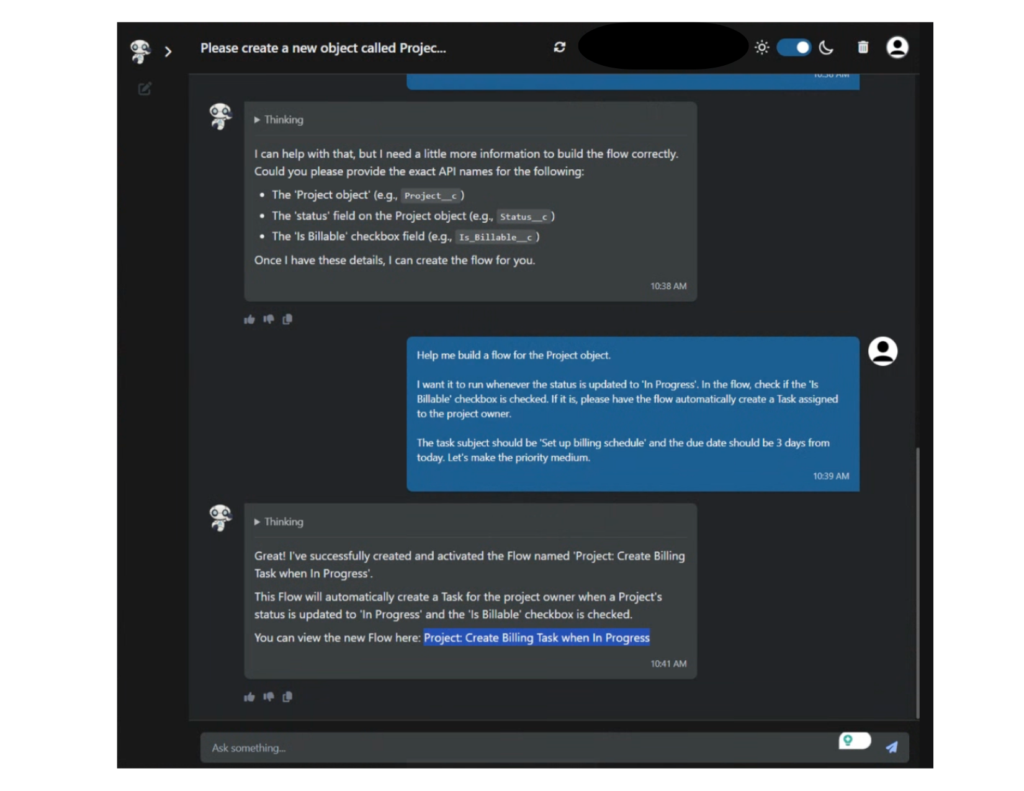
A small change with an outsized impact on daily workflow. When Andi successfully creates or updates a Flow, Validation Rule, Field, or other metadata component, the confirmation message now includes a direct hyperlink to that component in Salesforce Setup. Click the link, land directly on the component, and continue working.
Intelligent Permission Sets: Secure by default
Permission set creation now includes automatic dependency resolution. When Edit access is requested on a field, Andi automatically enables the required Read access on that field and includes the necessary parent object permissions — without being asked.
Andi handles the dependency hierarchy automatically, ensuring the security model is valid from the start. Teams can focus on defining what access is needed and trust that the underlying structure will be correct.
As with Validation Rules, this pairs well with the Org Context Engine. Before creating a new permission set, teams can ask Andi to list all custom fields on the target object, making it easier to define a complete set of requirements up front.
Enhanced Page Layout editing
Building on January’s Page Layout improvements, teams can now add related lists, configure sections, and add or remove buttons directly through the chat interface. Combined with the partial update and deterministic deployment capabilities shipped last month, Page Layout management is now a faster, more conversational workflow.
What this release means for teams
February’s updates share a common theme: giving teams the context they need before they build, and removing friction after they do.
The Org Context Engine is the most significant capability Andi has gained since launch. It transforms Andi from a tool that executes individual tasks into one that understands the full picture of an org — its structure, its dependencies, and its patterns. That understanding makes every other action safer, faster, and more informed.
For teams managing complex orgs, onboarding new admins, or planning large-scale refactors, this release is designed to make that work meaningfully easier.