Beyond the Syntax: Unlocking the Power of Snowflake Cortex Code
As data engineers, we have spent years focusing on building clean pipelines, reliable transformations, and scalable data models. Our job has always been to ensure that data is trusted, accessible, and ready for analytics. But recently, something has shifted. The conversations are no longer just about dashboards or performance tuning. They are about AI, automation, and making data systems smarter.
When I first explored Snowflake Cortex Code (aka CoCo), I did not see it as just another feature release—I saw it as Snowflake acknowledging where data engineering is headed. It brings AI capabilities directly into the Snowflake ecosystem, which means we can build intelligent use cases without moving data out of the platform or stitching together multiple external services. That changes the way we think about architecture, security, and even development workflows.
What excites me most is not just the AI functions themselves, but the simplicity. The ability to generate embeddings, summarize text, classify information, or power AI-driven applications directly where the data already lives reduces complexity significantly. For teams like ours, that means fewer integrations to manage and more focus on delivering business value.
I want to share my perspective on Snowflake Cortex Code from a hands-on engineering lens: what it actually does, where it fits in modern data architecture, and how we as data engineers can start thinking beyond traditional transformations toward building truly intelligent data platforms.
What is Snowflake Cortex Code?
Snowflake Cortex Code is not just another “AI chatbot” that writes generic SQL. It is Snowflake’s new AI coding agent designed specifically for the enterprise. Unlike generic coding assistants that guess based on public internet data, Cortex Code runs inside your Snowflake environment, understanding your specific schema, governance rules, and operational context.
What’s in it for a data engineer?
For those of us in the trenches, Cortex Code acts as a force multiplier that removes the friction from development.
- Context Over Guesswork: Unlike generic AI tools, Cortex Code understands your specific data lineage and table structures. You don’t have to waste time explaining your schema.
- Workflow Continuity: With the new Cortex Code CLI, you can stay in the environment you prefer—like VS Code—without constant context switching.
- Focus on Architecture: By automating the heavy lifting of writing boilerplate MERGE statements or transformation pipelines, you can elevate your focus to data modeling, performance optimization, and solving complex architectural challenges.
Unlike generic coding assistants (like GitHub Copilot or ChatGPT) that may hallucinate table names or suggest syntax from outdated Postgres versions, Cortex Code is metadata-aware.
- Schema Awareness: It scans your specific INFORMATION_SCHEMA. It knows that your T_ORDERS table joins to T_CUSTOMERS on CUST_ID, not CUSTOMER_ID.
- Cross-Language Fluency: It moves seamlessly between SQL and Snowpark Python. You can ask it to “convert this SQL CTE into a Snowpark DataFrame transformation,” and it handles the syntax translation instantly.
- Workflow Continuity: With the Snowflake Visual Studio Code Extension and the Cortex Code CLI, developers can generate, debug, and execute code directly from their local IDE, maintaining their existing Git-based CI/CD workflows without hopping back and forth to the web UI.
Cortex Code speedrun: Medallion layer creation & KPIs for reporting
To understand more on how Cortex Code helps us in development activities, following is how an instruction guide for Building KPIs for reporting from an orders data would look like,
- Start with Source Data: Begin with the raw
orderstable, which is located in the Bronze schema of the source database,SAMPLE_DB. - Initial Copy: Instruct Cortex Code to create a copy of the raw
orderstable into the designated working database,COCO_TRIAL. - Single Architectural Prompt: Pass a set of instructions to Cortex Code to create a complete Medallion Architecture (Bronze, Silver, Gold) by prompting it to perform necessary transformation regulations and identify key KPIs.
- Silver Layer Creation: The Silver Layer object,
SILVER.ORDERS_CLEANSED, is created, representing the cleansed and transformed data. - Gold Layer Creation: The Gold Layer fact table,
GOLD.FACT_ORDERS, is created as part of the final architectural objects. - Final Reporting View: The walkthrough concludes with the creation of the final reporting view,
GOLD.VW_ORDERS_KPI.
Key features demonstrated
- Context-Aware Code Generation: Cortex Code analyzes all the schemas of your database and identifies which table you want to copy.
- Automated Architectural Layering: It understands complex data engineering patterns, automatically structuring SQL to fit the Bronze (Raw) to Silver (Clean/Refined) to Gold (KPI/Aggregated) based on a single prompt.
- Data Transformation: The raw data was transformed and cleansed into the Silver Layer object (SILVER.ORDERS_CLEANSED).
- Semantic Logic Translation: It converts high-level business intents (e.g., “create KPI views”) into precise technical definitions (aggregations, ratios, and window functions).
- Ready-for-Reporting Data: A final view containing key business metrics (KPIs) was generated, ready for immediate use in reporting and analysis.
- End-to-End Pipeline Creation: Instead of generating isolated snippets, it constructs a cohesive workflow that links raw data source objects to final consumption views and intelligently proposes and generates relevant downstream transformations without requiring manual column mapping.
The value for developers
- Accelerated Time-to-Value: Drastically reduces the “blank page” problem by minimizing the effort to create a multi-layer architecture, allowing developers to move from raw data to insights in minutes rather than hours.
- Utilizing Best Practices: Enforces consistent coding standards and architectural patterns (like Medallion) automatically, reducing technical debt and ensuring scalability from day one.
- Reduced Cognitive Load: Offloads the repetitive task of writing standard SQL for joins, casting, and transformations, freeing up developers to focus on validating business logic and refining metrics.
The value for the business
Technical efficiency has increased with the use of Cortex Code, but for business leaders—CFOs, CDOs, and VPs of Analytics—the impact of Cortex Code goes far beyond saving a few hours of coding. It fundamentally changes the economics of your data strategy.
Accelerating time-to-market
In today’s market, the speed of decision-making is a competitive advantage. Traditional data pipelines can take weeks to build and harden. By accelerating the development lifecycle, Cortex Code drastically reduces the time between a business question (“How is churn trending?”) and a deployed, production-ready answer. This means your organization can react to market changes in days, not months.
Maximizing engineering ROI
Data engineering talent is scarce and expensive. You want your best engineers solving your hardest problems—optimizing supply chains, predicting customer behavior, or integrating complex systems—not writing routine SQL queries. Cortex Code optimizes your resource allocation, ensuring that your high-value talent is focused on high-value tasks.
Enterprise-grade security & governance
One of the biggest risks with Generative AI is data leakage—developers copying sensitive internal data into public AI tools to get help with code. Cortex Code operates entirely within Snowflake’s secure governance boundary. Your data never leaves the platform, and the AI respects your existing security controls. You get the innovation of AI without the compliance headaches.
Reducing the IT backlog
Every data leader knows the pain of the “IT Backlog.” By empowering analysts and less technical team members to prototype and understand pipelines using natural language, Cortex Code democratizes data access. This reduces the dependency on central IT for minor requests, allowing business units to move faster and be more self-sufficient.
Drive more value with Atrium
At Atrium, we know that tools are only as good as the strategy behind them. You can’t just “turn on” AI and expect it to fix broken data processes.
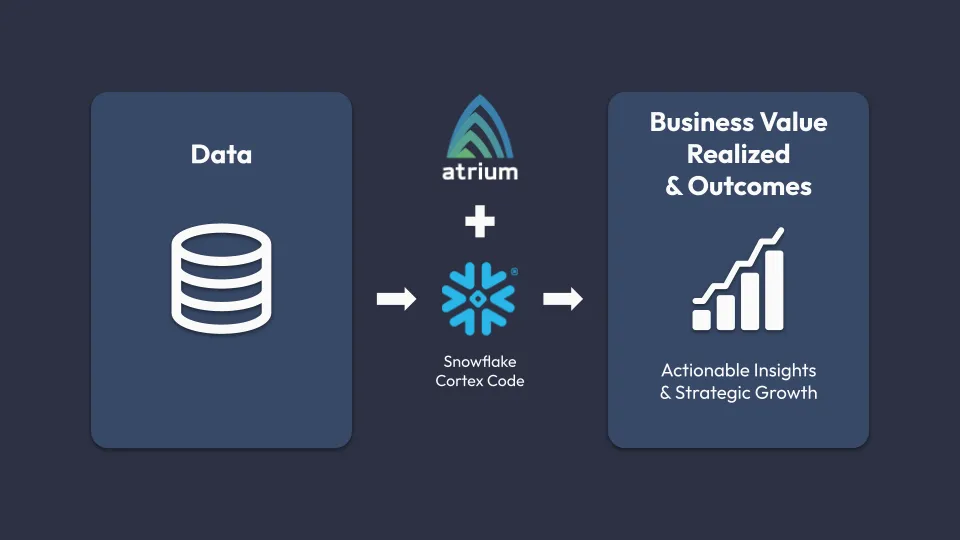
As an Elite Snowflake implementation partner, we help you bridge the gap between business goals and technical implementation by translating your business requirements into solutions using Cortex Code.
- Building the Foundation: Cortex Code relies on a clean, well-structured data environment. We help you design and build robust data architecture that allows the AI to function accurately.
- Strategic Alignment: We work with your stakeholders to define the business logic and KPIs that the AI needs to understand. We ensure the “Semantic Layer” reflects your actual business goals, not just database tables.
- Governance & Enablement: We implement the security frameworks that ensure Cortex Code assists your developers without compromising compliance. Furthermore, we don’t just build it and leave; we train your teams to transition from legacy coding habits to AI-assisted workflows.
- Consumption Control: Cortex Code operates under Snowflake’s existing, transparent consumption-based pricing model, allowing leaders to easily track and control the ROI of AI-assisted development. We help you keep things in check.
Ready to modernize your development?
If your organization is looking to move from “experimenting with AI” to “building production pipelines with AI,” the combination of Snowflake Cortex Code and Atrium’s expertise is your path forward.
Let’s stop writing basics and start building the future of your data. Reach out to learn how we can help you maximize the usage of Snowflake Cortex Code and unlock the true potential of your data team.