


Cortex Code Changed How I Think About Building on Snowflake
I spent some real time with Snowflake’s AI-powered CLI recently. Here’s my honest take on what it does, what surprised me, and why I think data teams should pay attention.
I tested this platform against a demanding real-world project by building a complete financial analytics proof of concept from the ground up. The build featured a semantic layer and a conversational AI agent alongside comprehensive stakeholder documentation. Here, I want to offer my unfiltered take on the capabilities of the tool and my thoughts on why it is a significant development for the field.
Digging into Snowflake Cortex Code
I have tried my share of AI coding assistants over the past couple of years. Most of them are decent at generating code snippets in isolation, and that’s about where the magic stops. What makes Cortex Code different is that it actually does what it claims to do.
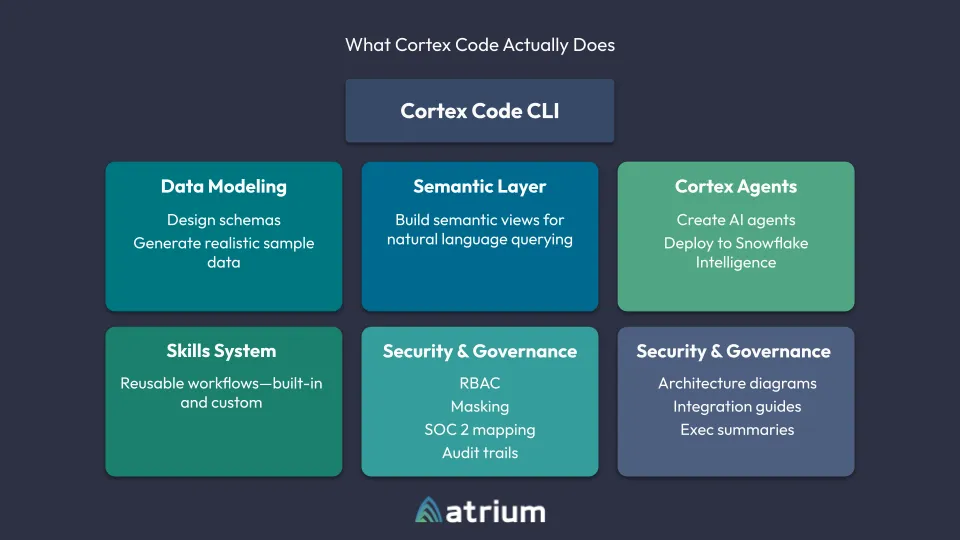
It doesn’t just suggest code and leave you to figure out the rest. It reads your local files, runs SQL against your Snowflake account, builds database objects, creates agents, generates documentation. All from a single terminal session. That felt very different from anything I had used before.
It understands business context, not just code
The first thing that struck me was how well Cortex Code picks up on business context. I gave it requirements documents describing a company’s pain points, stakeholder concerns, and what success looked like. And it didn’t just spit out generic SQL. The system designed a data model that truly mirrored the business by utilizing dimension tables for client segments and fact tables with realistic revenue mixes. It also generated expense categories that aligned perfectly with the way a genuine financial services firm structures its chart of accounts.
That matters more than it might seem. The hardest part of any POC is never the SQL itself; it’s translating what the business actually needs into a data model that makes stakeholders look at it and say, “Yes, that’s our business.” Cortex Code closes that translation gap faster than anything else I have worked with.
Semantic Views: the layer that makes everything click
If there’s one concept from my time with Cortex Code that deserves more attention, it’s Semantic Views. Think of a semantic view as a translation layer. This SQL object acts as a bridge that translates your data into business terms for the Snowflake AI. It defines exactly what metrics like total revenue represent and explains how your tables relate to one another while mapping common everyday language to specific database columns.
Cortex Analyst
Once that’s in place, Cortex Analyst can take a plain English question and turn it into accurate, auditable SQL. No training required for the person asking the question.
The word here is trust. In financial services, or really any regulated industry, you can’t just hand an executive an AI-generated number and expect them to run with it. They need to see how that number was calculated.
Cortex Analyst shows the SQL behind every answer. A VP of Operations can inspect the query. A Chief Compliance Officer can trace the logic step by step. It’s a glass box, not a black box—a distinction that means everything when you are presenting to stakeholders who have been burned by “just trust the model” before.
Snowflake Intelligence makes self-service real
While the industry has spent the last decade chasing the dream of self-service analytics, the truth is that the technical bar for entry has always remained far too high for most users. Business users still need to learn a BI tool, wrap their heads around a data model, or wait for someone on the data team to pull a report. Snowflake Intelligence, which is powered by Cortex Agents, gets closer to genuine self-service than anything I have come across.
Using Cortex Code, I created an agent, gave it system instructions written for financial executives, connected it to the semantic view, and deployed it to Snowflake Intelligence. The end result? A chat interface where a CFO can type “How is our revenue trending?” and get a sourced, accurate answer in seconds. Not a dashboard to click through. Not a report to request and wait for. Just an answer, with the receipts attached.
The Skills system is the sleeper feature
I’ll admit, Skills didn’t grab my attention right away. But looking back, they might be the single most important thing Cortex Code offers.
A Skill is basically a reusable workflow written as a markdown file. Cortex Code ships with dozens of built-in ones for things like building Cortex Agents, auditing semantic views, managing dbt projects, checking data quality, and plenty more.
The truly interesting part begins when you start creating custom Skills. I developed a Skill called financial-demo-prep that bundles an entire proof of concept workflow into one runnable playbook. It handles everything from gathering requirements and generating a schema to building a semantic view and creating a Cortex Agent. It even produces the final presentation talking points for you. Now any team member can run that Skill for a completely different client or scenario and get the same quality output without reinventing the wheel.
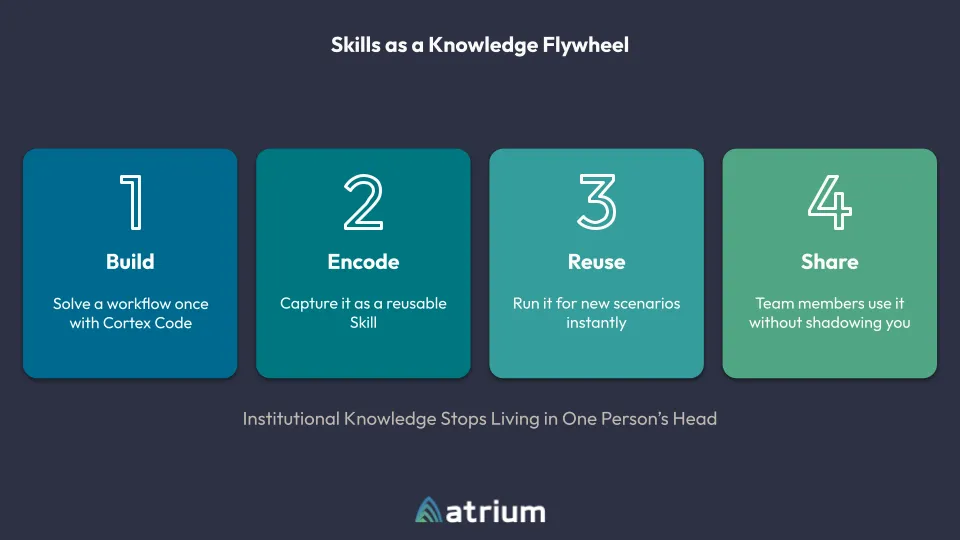
This is how expertise actually scales. Instead of writing a Confluence page that nobody reads, you write a Skill that actually runs. It’s documentation and automation rolled into one.
Documentation generation surprised me the most
I’ll be honest, I wasn’t expecting the documentation output to be all that useful. But it was. Cortex Code generated architecture diagrams in Mermaid, data integration guides covering each source system, security documentation mapped to SOC 2 criteria, role hierarchy diagrams, data validation queries, and executive summaries. All from the same context it had already picked up while building the POC.
If you have ever scrambled to pull together architecture docs the night before a leadership review, you know the pain. This alone justifies exploring the tool. The documentation comes out accurately because it’s generated from the same session that built the actual objects, not pieced together after the fact from someone’s memory of what they did two weeks ago.
Traditional approach: 2-3 weeks vs. Cortex Code: ~1 afternoon
A single session, a single tool
What gets me excited about Cortex Code isn’t any one feature in isolation. It’s how the entire workflow compresses. The distance between “I have a business requirement” and “here’s a working demo with full documentation” used to take weeks and involve multiple people, multiple tools, and a lot of handoffs. Cortex Code collapses all of that into a single session with a single tool. That’s a fundamentally different way to work.
For data engineers and BI analysts, it means you can prototype and iterate at the speed of conversation. For technical leaders, it means your team’s best practices can live in reusable Skills instead of in somebody’s head. And for business stakeholders, it means the gap between asking a question and getting a trustworthy, auditable answer shrinks from days to seconds.
Who needs Cortex Code?
If you are evaluating AI tooling for your data team and you are already working within the Snowflake ecosystem, Cortex Code is worth a serious look. Data teams will find the speed of POC development particularly transformative. Instead of presenting abstract concepts via slides, you can provide stakeholders with a tangible, interactive demo that bridges the gap between requirements and reality.
Regulated organizations often struggle with AI adoption due to a lack of trust. This platform overcomes that hurdle by providing full transparency into the SQL behind every AI response. When you combine that visibility with native security features like dynamic masking and audit trails, you solve the core compliance problems that typically stall AI projects.The Skills system allows teams to institutionalize excellence by turning the workflows of top performers into repeatable processes that anyone can execute.
If you are exploring how Snowflake and Cortex Code can unlock real value for your organization, our team at Atrium can help. We partner with teams like yours to turn ideas into production-ready solutions on Snowflake efficiently and at scale.