


Data Mesh Isn’t a Technology Decision, It’s an Organizational One
The Core Problem with Centralized Data Teams
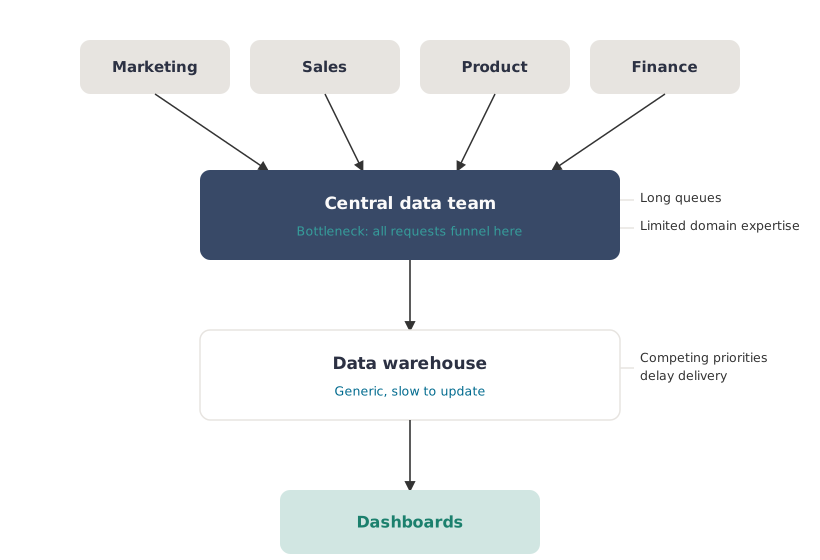
There are several critical business requests waiting to be addressed. The marketing team needs an attribution model to identify which channels drove conversions for the last campaign. The product team requires event analytics to understand where users are dropping off before activation. Meanwhile, the finance team needs revenue reconciliation to determine why Salesforce and the data warehouse report different numbers. The campaign has already ended, the board meeting is next week, and all three requests are still waiting in the queue. It’s the exact bottleneck Data Mesh was designed to break.
This is the centralized data team problem, and it is the default architecture at most companies. One team owns every pipeline, every model, every dashboard. They are forced to balance competing priorities across multiple domains, making it difficult to build deep expertise anywhere. Domain experts who actually understand the data sit three Slack channels away, helpless.
Why Centralization Has Worked, Until Now
Before dismissing the centralized model, it is worth acknowledging why organizations adopt it. A central data team offers consistent governance, unified tooling, and a single source of truth. For smaller organizations or companies with a single core product, this model works well. A team of two or three engineers can serve the entire business effectively.
The breakdown happens at scale. Competing priorities delay delivery. Limited domain expertise means pipelines are built correctly but lack the business context that makes them truly useful. The fix is not always hiring more central engineers. Sometimes it requires rethinking who owns the data altogether.
What Data Mesh Is
Data Mesh, coined by Zhamak Dehghani in 2019, is not primarily a technology architecture. It is an operating model that changes how data ownership is distributed across the organization. It rests on four principles.
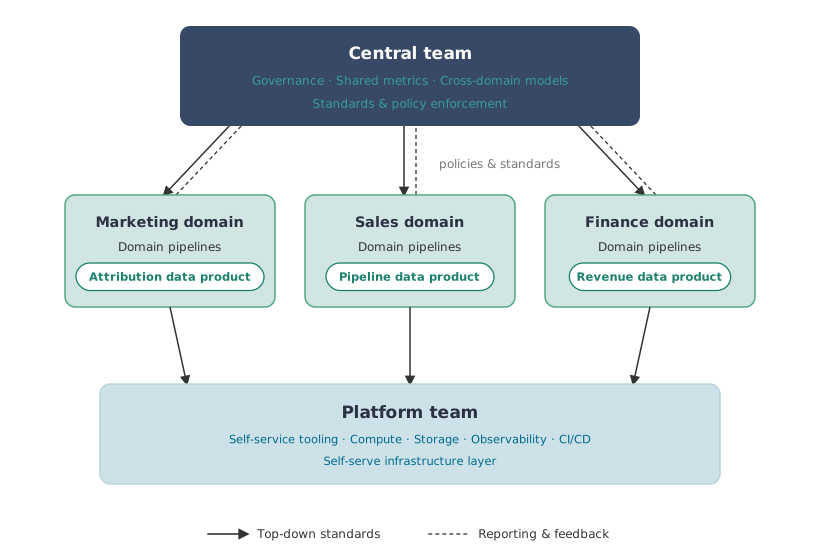
A common misconception is that Data Mesh eliminates central teams. In reality, ownership is decentralized, while governance and platform capabilities remain shared.
1. Domain ownership
In a Data Mesh model, domains own their business logic. Marketing owns marketing data. Sales owns sales data. Finance owns revenue data. Each team ingests, transforms, publishes, and maintains their own data end-to-end, without routing every request through a central intermediary.
Platform teams still own infrastructure. Domain ownership does not mean each team builds from scratch. It means business logic and domain-specific pipelines sit with the people who understand them best.
2. Data as a product
Treating data as a product means going beyond publishing a dataset. A data product has a clear contract, just like an API:
| Component | What it means in practice |
| SLA expectations | How fresh is the data? What uptime is guaranteed? What happens when it breaks? |
| Schema guarantees | What fields exist, what types they are, and how consumers are notified when they change. |
| Ownership & docs | Who maintains this dataset, how to reach them, and what the data represents. |
| Versioning | Consumers are not broken when the schema evolves. Deprecations are signaled in advance. |
3. Self-serve data platform
Domain teams should not need to become infrastructure experts. A platform team provides standardized, automated tooling: compute via Snowflake or BigQuery, ingestion via Fivetran or Airbyte, transformation via dbt templates, observability via Monte Carlo or Great Expectations, and CI/CD pipelines for automated testing and deployment. The platform team’s job is to make doing the right thing the easiest thing.
4. Federated computational governance
Shared rules, enforced automatically: not through a committee, but through the platform itself. PII detection, naming conventions, quality thresholds, and access controls are baked into the pipeline rather than bolted on after.
Centralized vs. Data Mesh: What Actually Changes
| Role | Centralized model | Data Mesh |
| Data engineers | Context-switch across Marketing, Sales, Finance, Product daily | Deep focus on one domain they understand well |
| Analytics engineers | Maintain 200+ dbt models across every business unit | Own 30 models with full business context |
| Data consumers | Submit ticket to central queue, wait 3–6 weeks | Work directly with domain owners in their own sprint |
| Governance | Enforced manually by a central team | Automated and embedded in the platform |
| Metric definitions | Risk of inconsistency across teams | Standardized via data contracts and a semantic layer |
Cross-Domain Analytics: The Hardest Problem
Decentralizing ownership solves the bottleneck problem but creates a new one: what happens when you need to join Marketing data with Finance data with Product data?
Cross-domain analytics requires deliberate coordination. Without it, “revenue” means three different things across three dashboards. There are no shared join keys between domain datasets. Analysts spend days manually reconciling numbers from different sources.
The solution is not recentralizing. It is establishing data contracts between domains before a domain publishes data that others will consume. A central semantic layer (dbt Metrics, Cube, or LookML) sits above domain data products, and resolves shared metric definitions across boundaries. This is where governance earns its place: not in approving every pipeline, but in setting the rules that make cross-domain joins possible.
While solving cross-domain joins requires deliberate architectural planning, it’s only the first of several hurdles teams face.
Key Challenges to Plan For
Beyond architectural silos, moving to a decentralized model introduces immediate cultural and operational friction. Watch out for these three common pitfalls:
| Competing definitions break trust Marketing, Sales, and Finance often define “revenue” differently. Without a shared semantic layer, dashboards show conflicting numbers, and leadership loses trust in data altogether. |
| Decentralization without governance creates better-looking silos Without a data catalog and automated quality checks, teams quietly build duplicate pipelines. You end up paying for twice the infrastructure and twice the engineering effort: the exact problem Data Mesh was meant to fix. |
| Most domain teams are not ready Owning data is a new responsibility. If the platform is not simple enough, data products get abandoned. Other teams stop trusting them and roll their own, recreating the same fragmentation. |
When Data Mesh Works, and When It Doesn’t
Data Mesh is not a universal upgrade. Here is where it earns its keep, and where it just adds overhead.
| GOOD FIT | POOR FIT |
| Large organizations with multiple autonomous business domains (Marketing, Sales, Finance, Supply Chain), each with distinct data needs | Small companies where a central team of two or three can serve everyone effectively |
| Organizations where the central team is a clear bottleneck to business decisions | Single-product companies where one domain makes mesh architecture unnecessary overhead |
| Companies with a mature data culture where domain teams already think about quality | Early-stage data teams that need centralized foundations before they can decentralize |
| Businesses with diverse data sources requiring unique ingestion per domain | Organizations without platform engineering capacity: mesh without a self-serve platform is chaos |
The Middle Ground: Federated, Not Full Mesh
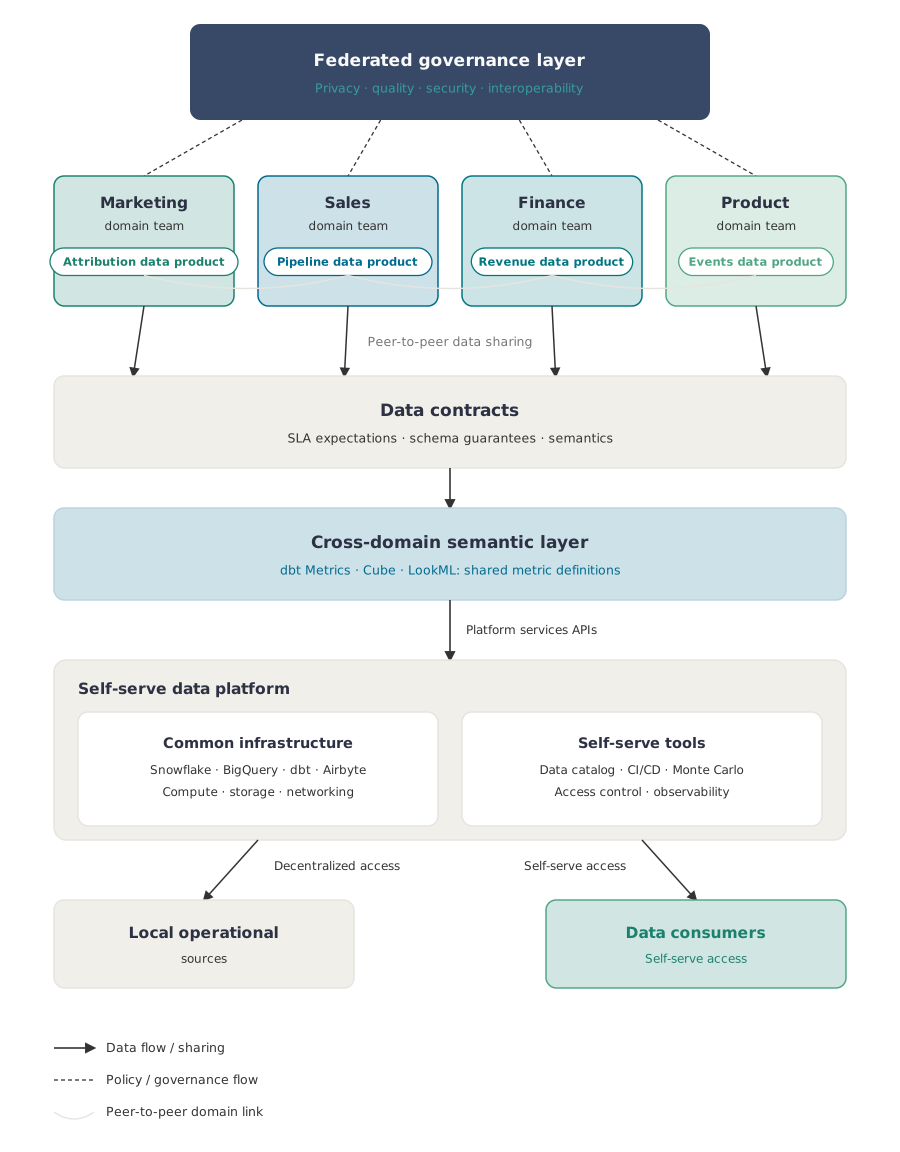
Most successful implementations do not go full mesh. They adopt a federated model that captures most of the benefit with far less organizational disruption.
Getting Started: A Pragmatic Approach
- Audit your bottleneck. Map every data request from the last quarter. Which domains generate the most tickets?
- Pick one domain. Choose the team that’s most frustrated and most capable. Let them own their data.
- Build the platform incrementally. Don’t try to build a complete self-serve platform upfront. Start with templated pipelines and a basic catalog.
- Define data contracts early. Before the second domain goes live, establish how domains will agree on shared definitions.
- Measure what matters. Track time-to-delivery for data requests, data quality scores, and team satisfaction. These metrics justify expanding the mesh.
The Bottom Line
Data Mesh is an organizational decision before it is a technical one. It trades centralized simplicity for distributed scalability, and that trade only makes sense when the centralized model has genuinely stopped working.
The organizations that get it right do not adopt it because it is trending. They adopt it because their central team is physically unable to keep up with business demand, and their domain experts are losing time waiting in a queue.
If that describes your organization, it may be time to distribute ownership. Just make sure you build the governance layer first, because decentralization without shared rules does not create a mesh. It creates fifty silos with better documentation.
Exploring Data Mesh adoption? If you need guidance on platform design, governance, or organizational readiness, the team at Atrium can help you assess the right approach for your environment.