



Salesforce Headless 360 and The Rise of Governed Autonomy
For years, Salesforce has been described as an API-first platform. Most organizations, however, still experienced Salesforce through a browser. Headless 360 changes that equation.
For the first time, Salesforce is positioning itself not simply as a user interface for managing customer relationships, but as an execution layer that can be accessed directly by AI agents, applications, and experiences operating outside the traditional CRM.
Salesforce Headless 360 is a platform-level shift that exposes every Salesforce capability as APIs, MCP tools, and CLI commands so that both humans and AI agents can operate Salesforce “without a browser” while still inheriting the full Customer 360 context, workflows, and guardrails.
For Financial Services Cloud (FSC)-heavy organizations, this opens up deep technical advantages in automation, agent-driven workflows, headless channels, and governance, especially for retail banking, wealth management, and lending.
This post explores what Headless 360 means specifically for Financial Services Cloud organizations, covering how headless front-ends and agent-driven channels change the way FSC logic is accessed, where the technology creates the most leverage in lending and servicing operations, how DevOps and delivery cycles benefit, and why the compliance and governance story may be the most compelling angle for regulated institutions.
What Headless 360 actually is
Headless 360 is a programmable layer over Salesforce that:
- Exposes data, metadata, workflows, and automation as APIs, MCP tools, and CLI commands.
- Gives AI coding agents (e.g., Claude Code, Cursor, Codex, VS Code-style agents) live access to your org, including FSC objects like Account, Contact, Individual, Party, Policy, Loan Application, and more, without UI-driven interaction.
- Bundles Agentforce Vibes 2.0, Experience Layer (Slack, chat, and voice-native experiences), and production controls such as Testing Center, Observability, Session Tracing, and A/B testing.
In effect, Salesforce becomes a “system of context and execution” for agents, not just a UI‑based CRM. That may be one of the most important architectural shifts in the platform since Salesforce first embraced APIs.
How this benefits Financial Services Cloud technically
Financial services journeys are increasingly channel-agnostic. Customers move between mobile apps, web experiences, advisors, service teams, messaging channels, and branches. Headless 360 creates new opportunities to support those journeys without requiring every interaction to begin inside Salesforce itself.
Headless front‑ends and agent‑driven channels
For FSC, many customer journeys are channel‑agnostic (web, mobile, WhatsApp, SMS, voice, in‑branch kiosks).
Headless 360 lets you:
- Build headless web/mobile apps (Next.js, React, Flutter, etc.) that call Salesforce APIs and MCP tools directly to:
- Fetch FSC‑backed customer profiles (via Data 360 / Customer 360).
- Mutate FSC objects (e.g., create a Loan Application, update Individual attributes, change Policy status).
- Use AI agents as “backends” that:
- Orchestrate FSC workflows (KYC, onboarding, loan decisioning, policy servicing) from messaging/voice channels.
- Call FSC business‑logic layers (Flows, Apex, Process Builder) via MCP tools instead of UI‑based clicks
This means channel-specific user experiences can be fully decoupled from FSC logic while still remaining governed by FSC security, sharing, and data models.
Agent‑driven automation in lending and servicing
- Headless 360 is especially powerful for digital lending and servicing in FSC. Loan origination agents can:
- Read bank statements, pay‑slips, or risk data via MCP tools (integrated with Document Intelligence / DocuSign / risk APIs).
- Query FSC‑backed Data 360 profiles to enrich income, spend, and relationship history.
- Call FSC workflows (e.g., approval flows, underwriting rules) programmatically rather than via UI‑driven “Case” routing.
Collections / servicing agents can:
- Automatically update Case or Service Request status, create Tasks, or push nudges to Messaging/Slack/WhatsApp based on FSC‑driven rules.
- Use Testing Center and Observability to monitor whether servicing agents are following compliance rules (e.g., “cannot skip X‑milestone before Y‑step”).
In practice, this reduces UI‑driven toil in agent consoles and moves complex workflows into agent‑orchestrated, API‑driven processes.
DevOps and technical velocity for FSC teams
For FSC practice leads and architects, Headless 360 also accelerates delivery. Agentforce Vibes 2.0 and MCP DevOps allow AI coding agents to:
- Analyze FSC metadata and code (Apex, Flows, OmniScript equivalents).
- Generate boilerplate (e.g., test classes, Mid‑milestone validation rules, CDP‑based FSC data mappings).
- Run deployments via DevOps Center MCP, describing “make this FSC change in UAT” in natural language and letting the agent execute it.
Testing Center adds another layer of governance by validating that FSC-driven decisions meet policy standards and that agents do not bypass security, privacy, or sharing controls.
Salesforce has stated that Headless 360, combined with Agentforce developer capabilities, can reduce development cycle times by up to 40%, helping teams move from idea to implementation more quickly.
Risk and compliance advantages
This may be where Headless 360 becomes most compelling for financial services organizations. FSC‑heavy use of Headless 360 is less risky than “raw‑API” agent stacks because:
- Agents inherit Salesforce security: profiles, permission sets, sharing rules, field‑level security, and FSC‑specific governance (e.g., Financial Services Cloud permissions model, Party Data Model, Data Use policies).
- Data 360 exposes unified, consented customer profiles as APIs, so agents don’t need to stitch data from raw DBs-reducing shadow‑data risk.
- Agent Fabric lets you centralize governance across multiple agents (Slack, WhatsApp, voice, custom portals) that all operate on the same FSC data and workflows.
The result is a single governed control layer for AI, even when those agents operate outside the Salesforce interface.
This is governed autonomy in practice: AI agents operating with real autonomy across FSC workflows, bounded by the same security, sharing, and data policies that govern human users.
FSC-specific implementation patterns
Here are a few practical patterns emerging for Headless 360 within Financial Services Cloud:
- Headless client portals for wealth and retail banking
Organizations can build branded wealth management or retail banking portals using React or Next.js while using Headless 360 APIs and MCP tools to read and write FSC objects.
Data 360 can expose propensity, risk profile, and life-stage information to agents, while document tools such as DocuSign MCP manage e-signature workflows.
The benefit is a fully FSC-backed experience without embedding Salesforce UI components.
- Agent-driven onboarding (KYC / AML)
Organizations can use WhatsApp, Slack, voice, or other channels as the primary engagement layer.
AI agents can create and update Individual and Party records, trigger FSC-integrated KYC workflows, and present document upload experiences, identity verification, and disclosures directly inside conversational experiences.
KYC becomes conversation-first rather than console-first while remaining governed by FSC.
- Agent-assisted lending decisioning
Headless lending applications can collect loan applications, income documentation, and consent information through mobile or web experiences.
Agents can create Loan Application records, enrich customer profiles using Data 360 data, invoke scoring services and integrations, and validate compliance requirements using Testing Center.
The result is faster, more auditable, and more consistent lending workflows.
- Agent-driven branch and field experiences
Branch employees and field representatives can use headless mobile applications that call FSC APIs to surface customer profiles, recommendations, and next-best actions.
Voice and Slack-based agents can prepare service requests, cases, and customer context before an employee ever engages with the customer.
This creates more contextual and efficient employee experiences while reducing navigation across multiple systems.
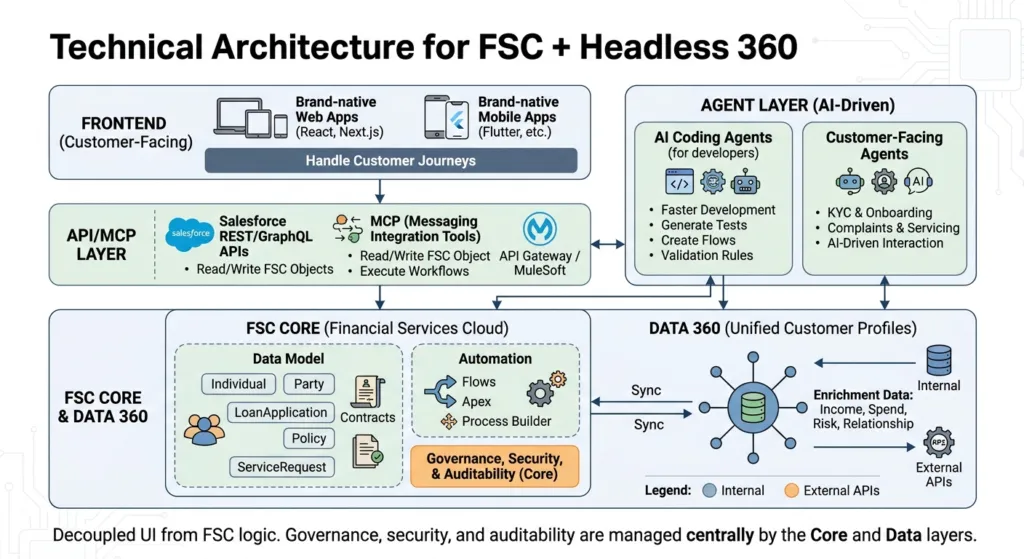
Technical architecture for FSC and Headless 360
For a typical financial services or digital lending practice, a Headless 360 and FSC architecture includes:
- Brand-native web and mobile experiences.
- Salesforce APIs and MCP tools for reading and writing FSC data and workflows.
- Financial Services Cloud as the operational core.
- Data 360 as the unified customer profile layer.
- AI agents supporting both development teams and customer-facing experiences.
This architecture allows organizations to decouple the user interface from FSC logic while maintaining governance, security, and auditability.
This architecture lets you decouple the UI from FSC logic while keeping governance, security, and auditability intact.
Final thoughts
Headless 360 is often described as a no-browser Salesforce. While technically accurate, that description undersells the broader shift.
What Salesforce is really doing is exposing the platform’s logic, workflows, governance, and customer context beyond the traditional CRM interface.
For Financial Services Cloud organizations, that creates opportunities to build headless customer experiences, accelerate lending and servicing operations, and introduce AI-driven automation without sacrificing governance.
The institutions that benefit most will not simply be the ones deploying more agents. They will be the ones that combine customer context, operational workflows, and AI execution into a trusted operating model.