



Snowflake OpenFlow: Simplify Complex Data Workflows
In today’s data-driven world, organizations are drowning in information scattered across countless platforms, databases, and applications. While data remains one of the most valuable assets for any company, accessing and utilizing it effectively has become increasingly complex. Getting all that data to talk to each other, and getting it into Snowflake, often feels like an overly complex and unstable project. It can be a messy, unreliable process that costs time and money.
What if it was possible to stop fixing broken connections and just let the data flow?
Why traditional integration falls short
Picture this: your sales data lives in Salesforce, marketing metrics are trapped in HubSpot, financial information sits in QuickBooks, and customer support data resides in Zendesk. Each system speaks its own language, creating data fragments that prevent organizations from gaining comprehensive insights. Traditional data integration approaches often involve complex coding, connections that break frequently, and maintenance nightmares that drain resources. Teams spend more time fixing broken pipelines than extracting valuable insights from their data.
Introducing Snowflake’s OpenFlow
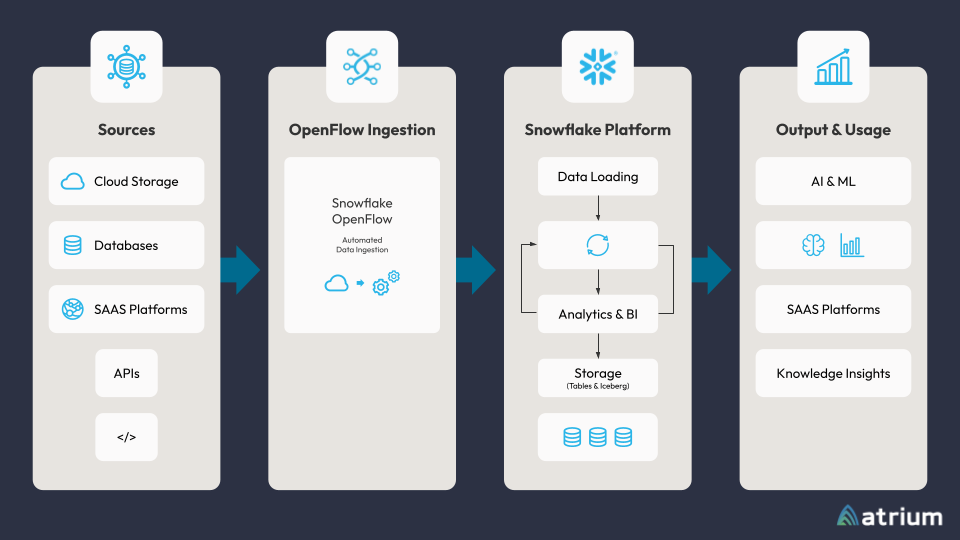
Snowflake OpenFlow is the simple, powerful answer to this chaos. Think of it as a powerful data connection system, built directly into Snowflake. Its main job is to move data from all those different, scattered sources and bring it safely into Snowflake. Instead of writing complex code that breaks easily, OpenFlow provides a clean, visual way to build these data connections. Users simply connect their source, like Salesforce or a marketing platform, to their destination in Snowflake, and OpenFlow handles the rest.
Why OpenFlow matters in the Snowflake ecosystem
The true value of Snowflake’s OpenFlow tool lies in its native integration with the Snowflake platform. In the past, businesses had to buy and manage separate, third-party tools just to get their data into Snowflake. This created an inefficient, expensive, and unreliable system, often meaning two different vendors, two bills, and two platforms that could break. OpenFlow eliminates this completely. It isn’t an add-on; it is built directly into the platform. This creates a single, seamless experience, which means unmatched reliability, lower costs, and a much simpler way of working, empowering data teams to deliver value instead of just managing integrations.
Openflow in action
OpenFlow’s most compelling feature is its visual, drag-and-drop interface, which turns complex data integration into intuitive workflows. Users can see their data connections, making it easy to understand, modify, and troubleshoot.
Imagine a flowchart where boxes are your data steps and arrows show its movement. This visual layout allows everyone, from analysts to data scientists and even non-technical stakeholders to understand and contribute. The days of “black-box” integrations that only one developer understands are finally over.
Seeing OpenFlow in action highlights its simplicity. It’s built right into the Snowflake interface, so no separate setup is needed. Just head to the Ingestion section, and you’ll find it waiting.
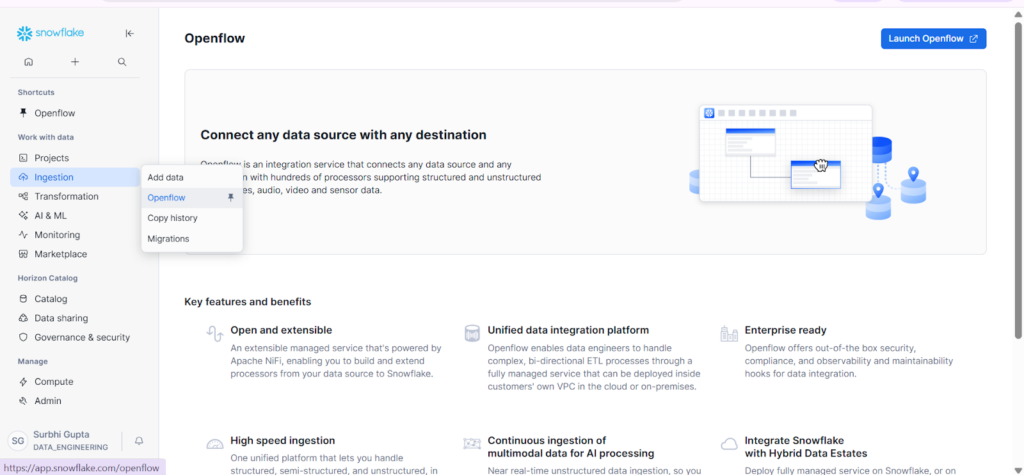
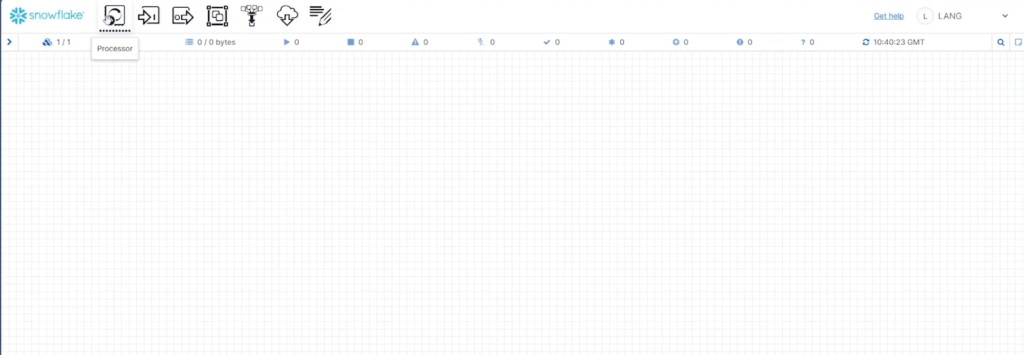
Click on it, and you’re greeted with a clean overview page that explains what OpenFlow does: connect data from any source to any destination. From here, you can launch a workspace, which opens a blank visual canvas to design and manage your data pipelines.
Here’s what a working flow looks like inside OpenFlow:
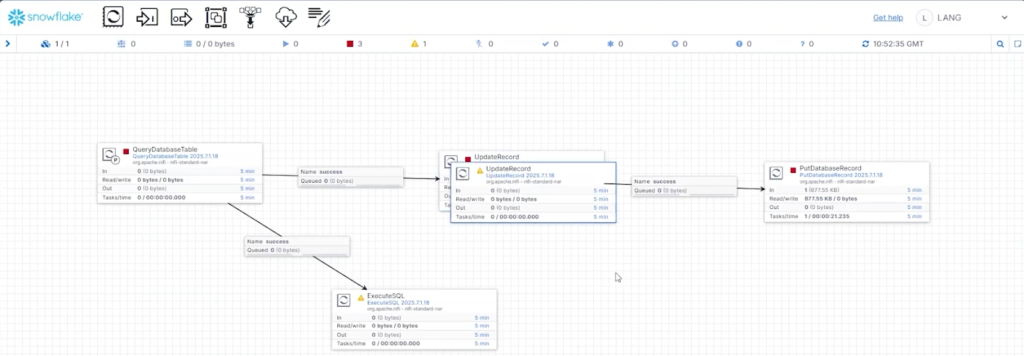
In this example, the flow starts by reading from a source table, updating or transforming the data, and then writing it back to a Snowflake target. You can see the steps clearly on the canvas, from QueryDatabaseTable to UpdateRecord to PutDatabaseRecord. The interface shows task details, run times, and data volumes in real time, so you always know what’s happening.
For anyone building or managing data workflows, this experience feels both familiar and refreshing. It’s a modern, hands-on way to simplify complex data movement, one flow at a time.
Current OpenFlow features: What OpenFlow delivers today
So, what can OpenFlow actually do right now? Its power is in its practical, everyday features. This isn’t just a concept; it’s a tool ready to work. It gives teams a clean, visual workbench to build data pipelines, think more “connecting the dots” and less “writing complex code.”
These connections are also impressively smart. If your source data suddenly changes, like a new column is added, OpenFlow can automatically adapt without breaking. It comes with pre-built connectors for common apps, and it’s flexible. It can move data at a planned time (like a daily report) or instantly as it happens.
You can even clean and filter data while it’s moving, ensuring it lands in Snowflake pure and ready for analysis. Best of all, it’s built to be reliable. It automatically handles errors and gives you a single place to see how everything is running, all protected by the same security you already trust.
Atrium’s POV
OpenFlow’s real value isn’t just its features, but how it shifts a team’s entire focus. It moves the conversation away from the technical headaches of data movement and starts talking about what the data can do for the business. This lets us help companies build new, data-driven solutions with a speed that wasn’t possible before.
Imagine a retail brand was using a costly third-party tool to ingest sales data from hundreds of store systems. This process was brittle, frequently failing and leaving analysts without data for morning reports. By replacing this external tool with Snowflake OpenFlow, they built a reliable, native workflow. This move eliminated a significant license fee and ensured that complete, accurate sales data was in Snowflake, ready for analysis, every single morning.
What’s new: Latest release highlights
Snowflake OpenFlow is now a production-ready service, making data integration smoother and faster than ever. Launched in May 2025 to connect any data source, structured or unstructured. It now runs on Snowpark Container Services for enterprise-grade scale and stability.
- Recent updates have focused on expanding connector libraries, improving performance optimization, and enhancing security features.
- New capabilities include advanced data lineage tracking, which helps organizations understand data flow and maintain compliance requirements.
- Enhanced monitoring dashboards provide real-time visibility into integration health and performance metrics.
The future of data integration is here
Snowflake OpenFlow simplifies data movement and speeds up the design of ingestion methods for diverse data types. As data volumes and business demands grow, Snowflake becomes essential for competitive advantage.
The question isn’t if you need better data integration, but whether you are ready for the future of seamless, visual, and powerful connectivity Snowflake provides. Reach out to us if you are looking to simplify your Snowflake data ingestion and need to smoothen your data operations using Openflow.