Databricks Lakebase vs. Snowflake Postgres: Which Managed Postgres Fits Your Workload?
TLDR/key takeaways:
- Lakebase vs Snowflake Postgres is a choice between two architectures on the same open-source Postgres engine: Databricks Lakebase separates compute from storage and scales to zero, while Snowflake Postgres runs each instance on a dedicated virtual machine with attached disks.
- Snowflake Postgres fits sustained, high-concurrency OLTP such as a core banking or payments migration, because dedicated compute and built-in PgBouncer pooling give predictable, isolated performance.
- Databricks Lakebase fits spiky or intermittent workloads such as AI agent state stores and dev/test, because idle compute suspends automatically and branches are created with copy-on-write in seconds.
- At list prices in AWS US East, Snowflake Postgres compute costs roughly three to four times less per hour than Lakebase at comparable memory sizes, but Lakebase bills no compute while scaled to zero.
So which one belongs under your next application?
For data engineers, one of the most persistent problems has been the wall between transactional databases (OLTP) and analytical platforms (OLAP). Crossing it has meant building and babysitting ETL pipelines that copy yesterday’s data into tomorrow’s dashboard.
That wall is coming down. Databricks announced general availability of Lakebase in February 2026, and Snowflake Postgres became generally available on February 24, 2026. Both put fully managed Postgres inside a data platform, which makes the Lakebase vs Snowflake Postgres decision one that architects are now facing in real roadmaps.
Both run the standard Postgres engine. Their architectures, design philosophies, and best-fit use cases are very different. This piece compares them across one architectural lens, three business scenarios, and list pricing, so you can match the engine to your workload rather than to a vendor’s framing. (A disclosure: Atrium is a Snowflake partner and does not partner with Databricks. Every product claim below links to the vendor’s own documentation so you can check the work.)
What is the difference between Lakebase and Snowflake Postgres?
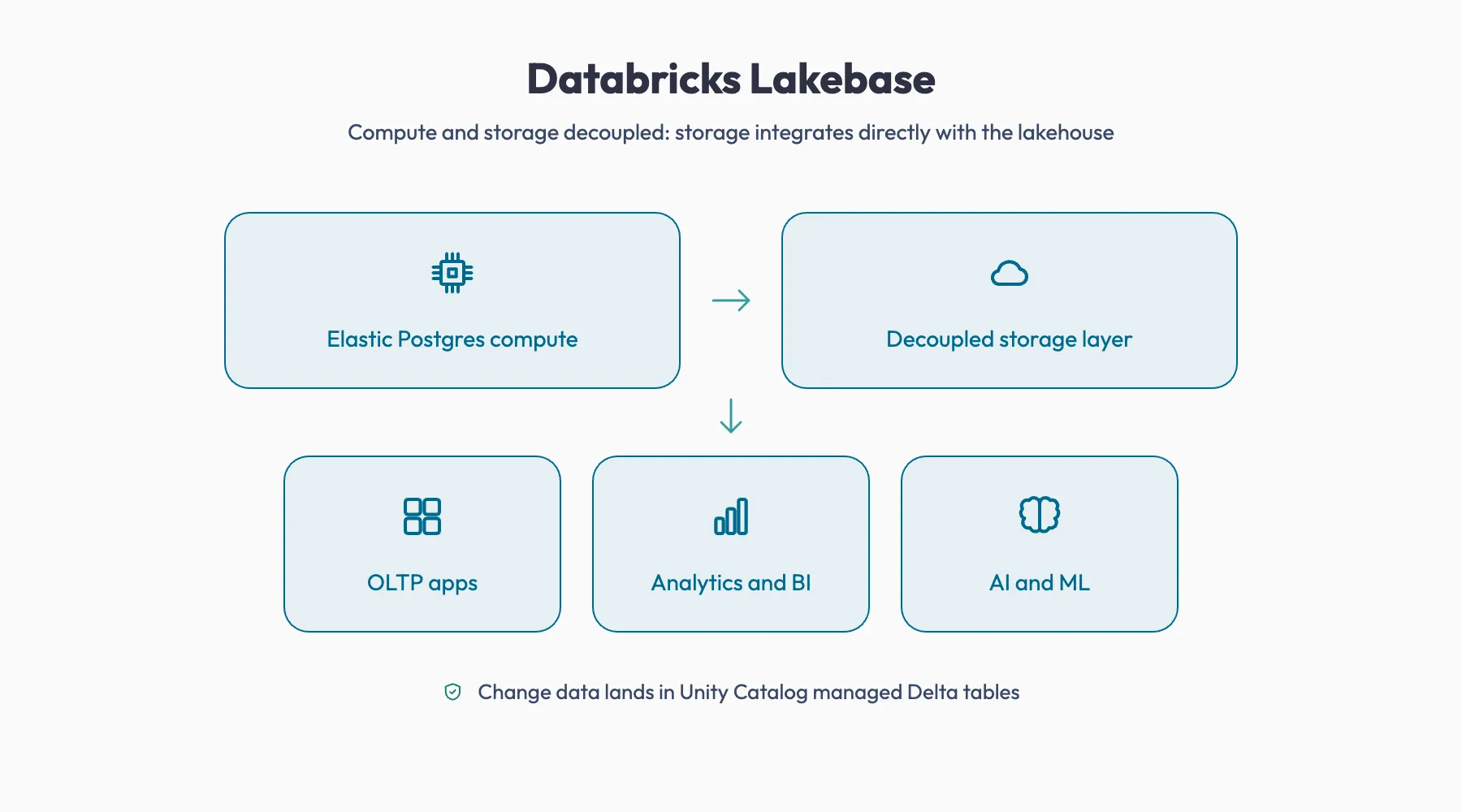
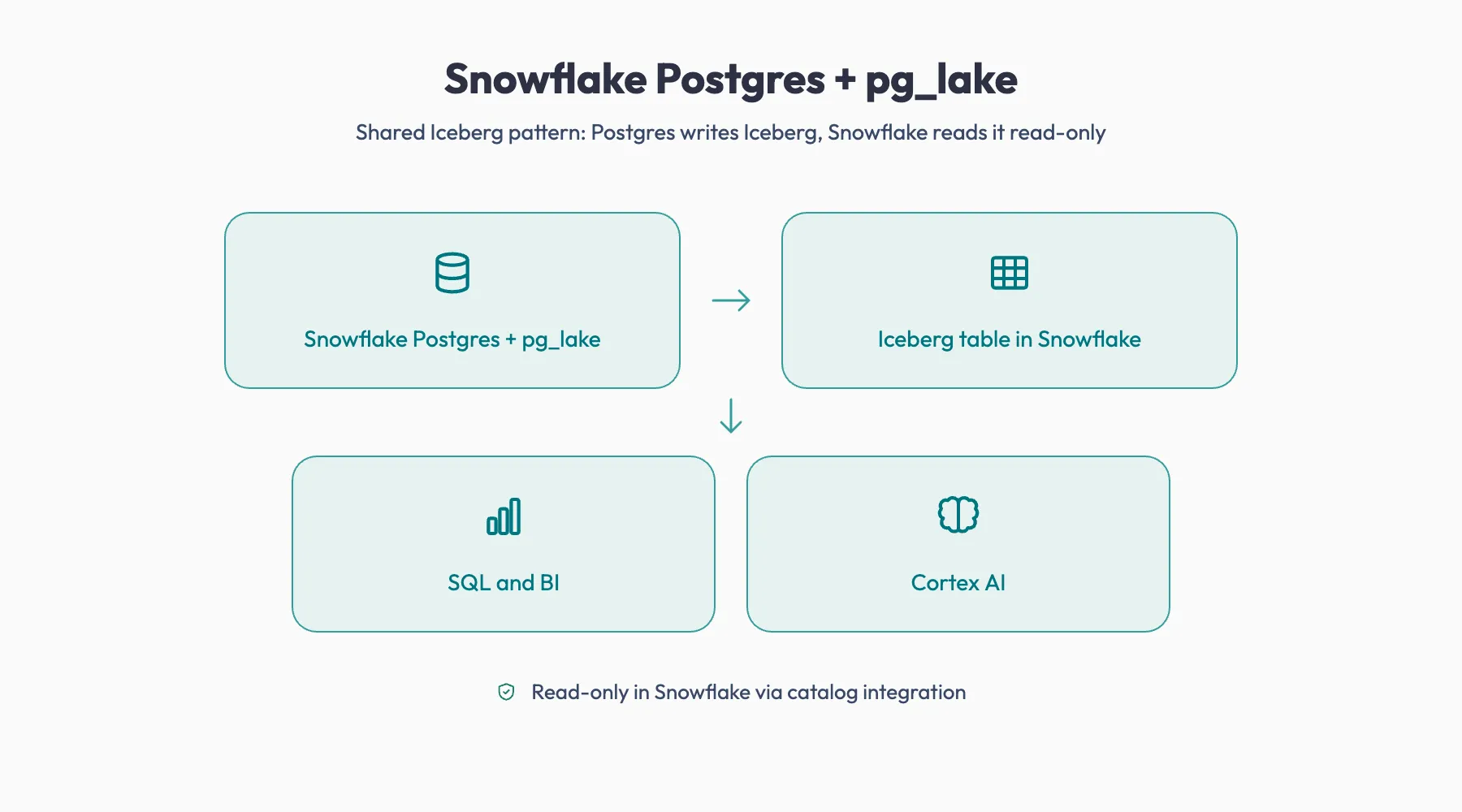
The core difference is where storage lives relative to compute. Lakebase decouples the two, so compute is an elastic layer that can disappear while storage persists. Snowflake Postgres keeps the classic Postgres model: each instance is a dedicated server with its own disks.
Databricks describes Lakebase as “decoupling the storage layer and integrating directly with the data lake.” Snowflake’s documentation says it “provisions a dedicated Postgres instance with attached disks,” and its preview announcement stresses that it is not a fork of Postgres. Every other difference in this comparison follows from that split.
The key architectural differences
| Dimension | Databricks Lakebase | Snowflake Postgres |
|---|---|---|
| Compute and storage | Decoupled. Compute is an elastic, serverless layer over a separate storage layer. | Bundled. Each instance is a dedicated VM with attached disks. |
| Scaling to zero | Idle compute suspends automatically and reactivates in a few hundred milliseconds. Storage persists. | Instances can be suspended manually. Compute billing stops, storage billing continues. |
| Branching and forking | A branch is a copy-on-write snapshot. Database size has no impact on creation time. | A fork restores the latest base backup and replays WAL onto a new instance. Time scales with instance size. |
| Path to analytics | Lakebase Change Data Feed writes row-level changes to Unity Catalog managed Delta tables. | The pg_lake extension writes Postgres data as Apache Iceberg tables that Snowflake queries in place. |
Which is better for a mission-critical OLTP migration?
Snowflake Postgres is the better fit for a lift-and-shift of a sustained, high-concurrency application. Picture a bank migrating a core banking or payments application that holds thousands of concurrent connections around the clock. The mandate is predictable low latency, resource isolation for audit, and minimal application rework.
| Dimension | Databricks Lakebase | Snowflake Postgres |
|---|---|---|
| Compute model | Serverless and autoscaling, with optional high availability across one to three secondary computes. | Dedicated VM and attached disk per instance, for consistent, isolated performance under constant load. |
| Connection handling | Autoscaling compute adjusts to traffic spikes. | Built-in PgBouncer connection pooling, documented for high-concurrency application workloads. |
| Compatibility | Standard Postgres clients connect. Documented limits include no superuser access and no native logical replication yet. | Not a fork of Postgres, positioned for lift-and-shift with no code changes using pg_dump and pg_restore. |
| Recovery | Point-in-time recovery configurable from 2 to 30 days (default 7). | Point-in-time recovery within a 10-day window, included at no extra charge. |
Assessment: Dedicated, isolated compute and a built-in connection pooler map directly onto predictable performance at high sustained concurrency. The compatibility story matters too: when the goal is moving an existing application with zero rework, “not a fork” is the claim you want to be able to test. If this is your scenario, a structured Snowflake migration plan is where to start.
Which is better for an AI agent state store?
Databricks Lakebase is the better fit for agent workloads with spiky, unpredictable traffic. Here a team is building an AI agent that needs low-latency reads and writes for conversation state and vector lookups. Usage is idle overnight and intense during business hours.
| Dimension | Databricks Lakebase | Snowflake Postgres |
|---|---|---|
| Cost under intermittent load | Compute suspends after a configurable idle timeout (as short as 60 seconds) and resumes on demand. You pay for agent activity, not idle capacity. | Instances can be suspended, but suspension is a manual, administrative action rather than automatic scale-to-zero under live traffic. |
| Native AI integration | Documented patterns for agent conversation state and memory, plus online feature stores for Model Serving. pgvector is supported. | Snowflake positions it for building agents and apps that reason over transactional data with Cortex AI. pgvector is supported. |
| Governance of agent data | Change data lands in Unity Catalog managed Delta tables, under the same governance as the rest of the lakehouse. | Each instance runs in its own private network by default. Data written through pg_lake becomes Iceberg tables that Snowflake reads in place. |
Assessment: Scale-to-zero economics match the shape of agent traffic, and the documented product surface (agent memory, feature serving, pgvector) targets this exact use case. One caveat worth knowing before you design around it: scale-to-zero is available only on computes of 32 CU or smaller and not in a high availability configuration. If your agents already reason over Snowflake data, Snowflake Cortex AI changes the calculation.
Which is better for zero-ETL operational analytics?
This one is a tie, and any claim of a clear winner would be overreach. An operations team wants dispatch and inventory writes (OLTP) and executive dashboards (OLAP) to stay in sync without standing up a separate ETL or CDC tool.
| Dimension | Databricks Lakebase | Snowflake Postgres |
|---|---|---|
| Mechanism | Lakebase Change Data Feed captures every insert, update, and delete from the write-ahead log into a Unity Catalog managed Delta table. | pg_lake writes Postgres data as Apache Iceberg tables, which Snowflake reads through a catalog integration. |
| Native format | Delta Lake | Apache Iceberg (why that format matters) |
| Where the value lands | Best when your BI and AI already run on Databricks SQL and Unity Catalog. | Best when your BI and AI already run on Snowflake warehouses and Cortex. |
| Maturity (September 2026) | Lakebase Change Data Feed is in Public Preview. | The catalog integration reached GA on July 14, 2026. pg_lake requires the Standard or High Memory tier, not Burstable. |
Assessment: Both remove the standalone ETL or CDC tool, and neither path is fully mature yet. The deciding factor is not the technology. It is which platform already holds your analytics, because the one you pick will pull your operational data toward its own catalog and governance model.
Lakebase vs Snowflake Postgres pricing: what you pay at list
At list rates, Snowflake Postgres is cheaper for always-on workloads and Lakebase is cheaper for workloads with real idle time. The tables below use published rates from the Lakebase pricing page and Snowflake’s Credit Consumption Table (effective September 23, 2026).
Compute, AWS US East, $/hour
| Comparable RAM | Databricks Lakebase | Snowflake Postgres, non-HA | Snowflake Postgres, HA |
|---|---|---|---|
| About 2 GB | 1 CU: $0.111 | BURST_S: $0.027 | Not available (Burstable has no HA) |
| About 4 GB | 2 CU: $0.222 | BURST_M: $0.054, or STANDARD_M: $0.071 | STANDARD_M: $0.142 |
| About 8 GB | 4 CU: $0.444 | STANDARD_L: $0.142 | STANDARD_L: $0.285 |
Storage, AWS US East
| Meter | Databricks Lakebase | Snowflake Postgres |
|---|---|---|
| Database storage | $0.345 per GB-month | $117.76 per TB-month (about $0.12 per GB), or $235.52 per TB-month with HA |
| Point-in-time recovery | Separate meter: $0.20 per GB-month | 10 days of backups included |
| Dev and test copies | Branches bill only for changed data. Snapshots: $0.09 per GB-month. | A fork is a full new instance, billed at its own compute and storage rate. |
Assumptions: AWS US East. Lakebase at the Enterprise tier, where each CU allocates about 2 GB of RAM. Snowflake Standard edition at an assumed $2.00 per credit (check your contract rate). Data transfer and egress excluded. Sizes are comparable by memory, not an exact spec match.
At those rates, Snowflake Postgres compute runs roughly three to four times cheaper per hour than Lakebase at comparable non-HA sizes, and database storage runs about 1.5 to 3 times cheaper. Two things move that math. Databricks is advertising 50% off the listed Lakebase prices until January 31, 2027, which narrows the compute gap to roughly 1.5 to 2 times while it lasts. And Lakebase bills no compute while scaled to zero, while a suspended Snowflake Postgres instance keeps accruing storage charges. Snowflake Postgres tends to win on cost for predictable, continuously running OLTP. Lakebase tends to win for spiky, dev/test, or agent-driven workloads with genuine idle time.
Choose by traffic shape and analytics home, not by engine
You are not really choosing a Postgres. You are choosing which platform your transactional data gets pulled toward. The engine is the same open-source core either way. The decision reduces to two questions.
What does your workload’s traffic look like?
- Sustained, high-concurrency, and predictable: Snowflake Postgres, where dedicated compute and pooling give you performance certainty.
- Spiky, unpredictable, or dev/test heavy: Lakebase, where serverless compute saves real money and branching speeds up development.
Where do your analytics and governance already sit?
- Standardized on Snowflake warehouses and Cortex: Snowflake Postgres keeps you on one bill, one governance surface, and one support relationship.
- Standardized on Unity Catalog, Delta, and Databricks SQL: Lakebase’s Change Data Feed path is a natural extension, not a new system to learn. (For a similar platform-philosophy split in AI coding tools, see our Cortex Code vs. Genie Code comparison.)
If you run both platforms today, that is the strongest signal to run a proof of concept on your actual concurrency profile and cost model instead of defaulting to either vendor’s framing, including ours. Our Snowflake data engineering team runs exactly this kind of workload assessment. The teams that get this right will stop treating the application database and the analytics platform as separate lake and warehouse decisions, and start treating them as one architecture.
Frequently asked questions
What is Databricks Lakebase?
Databricks Lakebase is a fully managed, serverless Postgres database built into the Databricks platform. It separates compute from storage, scales idle compute to zero, supports copy-on-write branching, and can stream row-level changes into Unity Catalog Delta tables through Lakebase Change Data Feed.
What is Snowflake Postgres?
Snowflake Postgres is a fully managed PostgreSQL service inside Snowflake that runs each instance on a dedicated virtual machine with attached disks. It is not a fork of Postgres, includes PgBouncer connection pooling, and uses the pg_lake extension to expose Postgres data to Snowflake as Apache Iceberg tables.
Is Snowflake Postgres cheaper than Databricks Lakebase?
At list prices in AWS US East, Snowflake Postgres compute costs roughly three to four times less per hour than Lakebase at comparable memory sizes, before promotional discounts. Lakebase can cost less for intermittent workloads because it bills no compute while scaled to zero.
Does Snowflake Postgres scale to zero?
No. Snowflake Postgres instances can be suspended manually, which stops compute billing, but storage charges continue and there is no automatic scale-to-zero. Databricks Lakebase suspends idle compute automatically after a configurable timeout.
Can I migrate an existing Postgres application without code changes?
Snowflake positions Snowflake Postgres for lift-and-shift with no code changes, using pg_dump and pg_restore or logical replication. Lakebase accepts standard Postgres clients but documents limits, including no superuser access and no native logical replication yet.